
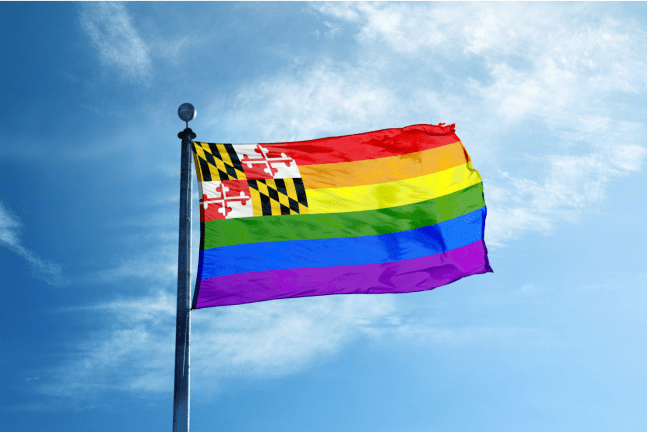
Maryland Pride: 5 Laws that Passed the General Assembly

Written By: Trevor Addie-Carter

LGBTQ Pride Month is celebrated every June to commemorate the Stonewall Uprising; to promote the self-affirmation, dignity, equality, and increased visibility of LGBTQ+ people; to remember those whose lives have been lost to hate crimes and HIV/AIDs; and to celebrate the impact that LGBTQ+ people have had in local, national, and international affairs.

While Pride Month offers LGBTQ+ people a chance to celebrate and be seen, it is also a stark reminder of the work that still needs to be done to achieve full equality for LGBTQ+ people.  LGBTQ+ people, especially transgender women of color, like many others, still find themselves the victims of bias-motivated crimes (“hate crimes”)—2019 FBI Uniform Crime Report statistics indicate that of the 7,103 single-bias incidents reported in 2019, 16.8% resulted from sexual orientation bias and 2.8% were motivated by gender-identity bias.

LGBTQ+ youth continue to face bullying and harassment in school, with the 2021 National Survey on LGBTQ Youth Mental Health indicating that 75% of LGBTQ+ youth reported that they had experienced at least one instance of discrimination based on their sexual orientation or gender identity, 48% were unable to receive the counseling from a mental health professional that they wanted, and 42% seriously considered attempting suicide in the last year, including more than half of transgender and nonbinary youth.

While these statistics are alarming, there are also many organizations working and advocating for the LGBTQ+ community.  The Frederick Center and FreeState Justice are some of the Maryland-specific organizations.  The Maryland General Assembly has also taken action.  Below are a few laws that the Maryland General Assembly passed in its 2021 Legislative Session:

  • “Bias Rage” and “Panic Defense” Ban (effective October 1, 2021) – Specifically establishes that the discovery of, perception of, or belief about another person’s race, color, national origin, sex, gender identity, or sexual orientation, whether or not accurate, does not constitute legally adequate provocation to mitigate a killing from the crime of murder to the crime of manslaughter, nor a defense to the crime of assault.
  • The Educate Against Hate Act (effective October 1, 2021) – Redefines the term “sexual orientation” in the context of hate crimes and includes gender identity in the list of protected classes, this law will also allow a Court to require an offender convicted of a hate crime to complete an antibias education program in addition to other penalties imposed.  Further, the law requires the University System of Maryland to manage the development of an antibias education program by January 1, 2023.
  • Mental Health Treatment – Minimum Age (effective October 1, 2021) – This law lowers from 16 years-old to 12 years-old the minimum age at which a minor can consent to consultation, diagnosis, and certain mental health treatment by a care provider.  While the law also allows the care provider to provide certain information to parents, guardians, or custodians under certain circumstances, there is also an exception if the provider believes that the disclosure will lead to harm to the minor or deter the minor from seeking care, making it easier for at-risk youth (including LGBTQ+ youth) to access mental health services.
  • The Maryland Commission on LGBTQ Affairs (effective October 1, 2021) – This law establishes the Maryland Commission on LGBTQ Affairs in the Governor’s Office of Community Initiatives.  In addition to providing the framework of the Commission, the law will also require the publication of an annual report which includes recommendations on policies to end discriminatory practices in the State.
  • Waiver of Name Change Publication (effective October 1, 2021) – This law creates a statute in the Courts & Judicial Proceedings Article of the Code of Maryland which requires a Court to waive the publication requirement in a Name Change case upon a request to do by the Petitioner asking for the name change.  Previously, any person asking to change their name would be required (unless the Court granted an exception) to publish information pertaining to the name change in a local newspaper.  Prior to this statute, there was no guidance provided to Judges on what constituted appropriate grounds for an exception.

The legal landscape is ever changing, and these laws are just a few laws that Maryland passed in 2021, but for many people whose lives these changes will improve, they serve as a symbol that progress is being made.

Zantac and Ranitidine Cancer Lawsuit

Horman Nichols Attorneys at Law are offering free consultations in the Maryland area for the Zantac/Ranitidine Lawsuit.

Currently, there is a class action lawsuit against the manufacturers for the over-the-counter heartburn medication Zantac and its generic form Ranitidine. In April 2020 both drugs were recalled due to producing dangerously high levels of NDMA, a cancer-causing chemical.

If you’ve taken Zantac/Ranitidine, and have been diagnosed with cancer as a result, Horman Nichols is prepared to file a lawsuit on your behalf.

Call Horman Nichols for a free consultation. 301.663.8101

New Laws Taking Effect on October 1, 2020

This is a sample of the new laws taking effect on October 1, 2020. A full list can be found on the Maryland General Assembly’s website (http://mgaleg.maryland.gov/mgawebsite/Legislation/Report?ID=chapters).

1.      Anti-discrimination laws:  This new law, among other things, prohibits employment discrimination based on certain traits, such as hairstyle and hair texture, associated with race.  Specifically, the bill prohibits discrimination on the basis of a “protective hairstyle,” which includes “braids, twists, and locks,” and clarifies that the definition of “race” also includes “traits associated with race, including hair texture, afro hairstyles, and protective hairstyles.”  

2.     Salary history and inquiries:  (a) Employers are required to provide the salary range to an applicant for the position for which they applied. (b)     Employers are prohibited from making salary history inquiries to an applicant or former employer. This does not prohibit an employee from volunteering their salary history. (c) Employer are prohibited from retaliating against or refusing to interview, hire or employee an applicant who requests salary information or refuses to provide their salary history.  (d) Employers are prohibited from taking action against an employee who asks about their own wages.   

3.     Notice requirements to employees prior to layoffs:  This amendment applies to employers with at least 50 employees that operate an industrial, commercial or business enterprise in Maryland for at least one year. Employees who work on average, less than 20 hours per week or employees who have worked less than 6 months in the immediately preceding 12 months are not counted in the 50-employee requirement.  Notice must be given:  (a) When an employer is relocating part of its operations to another existing site or a new proposed site.  (b) The shutting down of a workplace or a portion of the operations of a workplace that reduces the number of employees by the greater of either 25% or 15 employees over a 3-month period.  (c) Usually notice must be given at least 60 days in advance.  (d) The notice must contain the name and address of the affected workplace, a supervisor’s name, telephone number and email address, whether the reduction in operations is expected to be permanent or temporary and whether the workplace is expected to shut down and when the expected reduction in operations is scheduled to begin.   

4.     The use of facial recognition software during pre-employment job interviews is prohibited without the applicant’s consent.   

5.     Child support guideline changes: Currently the law requires that a child have at least 128 overnight visits with each parent in order to qualify for shared custody in child support calculations.  The new law changes the threshold to 92 overnight visits.     

6.     Hate crimes and the use of symbols to threaten or intimidate:  A person is prohibited from placing or inscribing an item or symbol, including an actual or depicted noose or swastika with the intent to threaten or intimidate any person or group of persons on any real or personal property, public or private without the express permission of the owner.        

4 Tips in a Personal Injury Case

Not everyone wants to hire an attorney for their personal injury case, and if you consult with an attorney, you should know you have the right to negotiate a settlement with the insurance company without an attorney and you have the right to file a lawsuit without an attorney.

Whether you choose to represent yourself in your negotiations with an insurance company, or you’ve retained an attorney, here are four things to keep in mind.


Horman Nichols – Legal Q&A Coming Soon

Ever had a legal question or scenario, but before you invested the time and expense of retaining a lawyer, you needed some direction to make sure it was worthwhile? We understand – email your question to us (anichols@hormannichols.com) and we will pick a handful of questions to respond to via video on our social media platforms.


Do I Have to Arbitrate?

You’ve likely heard the terms “arbitrate” or “arbitration” before.  Arbitration is when parties with a dispute (perhaps over a contract, labor issue, etc.,) agree to allow a neutral 3rd-party (or parties, perhaps a panel of arbitrators) to decide how the dispute should be resolved.  This decision is binding on the parties and usually cannot be appealed.  It’s not uncommon that a lot of contracts you sign (cell phone, car rental, pest control services, etc.,) have an arbitration clause in them.

Arbitration can be helpful because it is often a more cost-effective means of resolving a dispute, for reasons including that the rules of evidence are relaxed and the time required to present each side’s case in an arbitration is usually significantly less than that required for a presentation to a jury.

However, it can be limiting to the parties.  It means you are waiving your right to a trial in front of a judge or a jury.  It also means your tools for gathering evidence, including documents and depositions (a process called discovery) may be severely limited.  The reality of most arbitration clauses is that they can provide a significant benefit to a corporation, while limiting the consumer.  For example, T-Mobile has filed a motion to compel arbitration in a federal case pending in Maryland.  Plaintiffs in the case allege that T-Mobile is using the arbitration clause to prevent a class-action lawsuit.

Generally, courts give a lot of deference to arbitration clauses and if a party files a Motion to Compel Arbitration, the court may very well grant it.  Always review contracts closely and understand what rights you’re giving up when you sign.

Can a College Be Legally Responsible for What Its Students Say?

college

An Ohio jury awarded $11 million in compensatory damages to Gibson’s Bakery.  Gibson’s filed a lawsuit alleging defamation against Oberlin College.  Students of Oberlin had accused Gibson’s of being racist after a white employee chased down a black Oberlin student who had attempted to use a fake ID to purchase alcohol, and was suspected of stealing alcohol by the Gibson’s employee.  According to court records, the student did plead guilty to attempted theft.

Students at Oberlin accused Gibson’s of being racist, and petitioned Oberlin to cut its ties to the bakery, which was a supplier to its cafeterias.  The lawsuit accused Oberlin of supporting the students’ claims of racism.

Floyd Abrams, a First Amendment lawyer, was quoted as saying, “The notion that uninhibited student speech can lead to vast financial liability for the universities at which it occurs threatens both the viability of educational institutions and ultimately the free speech of their students.”

Oberlin is no stranger to moral outrage.  In 2015, students accused the campus dining department and Oberlin’s dining vendor, of cultural appropriation and insensitivity, criticizing what they saw as poor attempts at multicultural cooking.

The jury will reconvene this week to decide on punitive damages.

Is your Maryland Driver’s License REAL ID Compliant

Beginning October 1, 2020, every traveler using their driver’s license to travel, will be required by TSA present a REAL ID compliant driver’s license.

Maryland is requiring that anyone with a State-issued license or identification card present the “Core Four” documents at their local MVA location.  These documents are being used to the license holder’s identification and address.

Maryland’s website has useful links to confirm if your current license or ID is compliant, a portal to schedule an appointment to bring in documents and other useful information.  Maryland DL

Major Drug Distributor Charged In Connection With Opioid Sales

We are all aware that our Nation is facing a major opioid crisis.  According to statistics, opioid drug overdose deaths increased from 8,048 in 1999 to 47,600 in 2017.  Currently, approximately 130 Americans die daily from opioid overdoses.

On Tuesday, federal prosecutors revealed that Rochester Drug Cooperative (“Rochester”), the nation’s sixth largest drug distributor, and its former CEO, face federal criminal charges in connection to the Nation’s opioid crisis.  Rochester ships to pharmacies across the northeast United States.  The charges stem from allegations that Rochester did not report suspicious orders to the DEA.

While this is a novel approach in prosecution, the ripple effect is likely to be significant and may cause concern for drug distributors who have thus far only faced the possibility of civil penalties.