
5 Essential Tips for Safe Traffic Stops

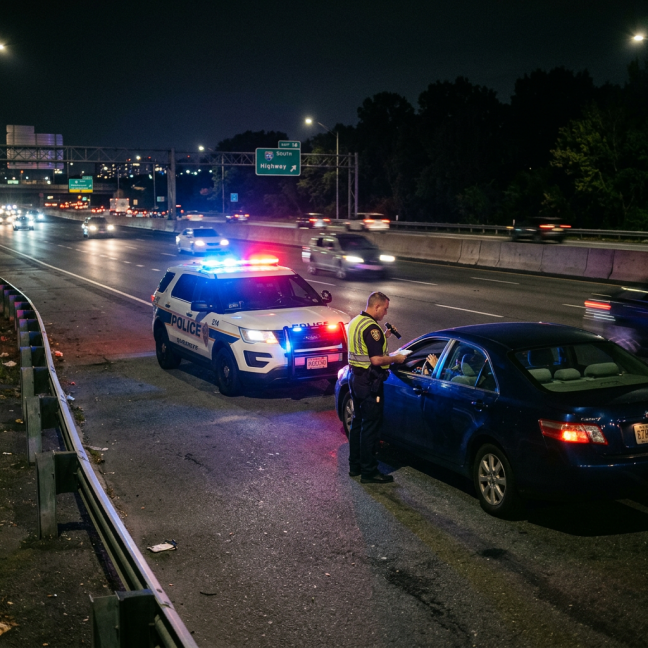
Police officer talking to driver during nighttime traffic stop on highway shoulder

Traffic stops are one of the most common interactions people have with law enforcement, yet many drivers are unsure about what they should and should not do when they see flashing lights in their rearview mirror. Remaining calm and knowing your rights can help make the encounter safer and less stressful for everyone involved.

5 Things to Keep in Mind When You’re Pulled Over During a Traffic Stop

Seeing flashing lights behind you can instantly raise your blood pressure. Whether you believe you did something wrong or not, how you handle the next few minutes can have a significant impact on the outcome of the encounter. Here are five important things every driver should keep in mind during a traffic stop.

1. Pull Over Safely and Promptly

When an officer signals for you to stop, do not slam on your brakes or make sudden movements. Instead, activate your turn signal and look for a safe location to pull over, such as a shoulder, parking lot, or side street.

A driver who continues for a short distance to reach a safe area is often viewed differently than someone who appears to be ignoring the officer. Once stopped, place your vehicle in park, turn off the engine if appropriate, and remain inside the vehicle unless instructed otherwise.

Remember: safety comes first for both you and the officer.

2. Keep Your Hands Visible

Officers approaching a vehicle have very little information about the occupants inside. One of the easiest ways to reduce tension during a traffic stop is to keep your hands where they can be seen.

Place your hands on the steering wheel and avoid reaching into pockets, under seats, or inside compartments without first informing the officer. If you need to retrieve your driver’s license, registration, or proof of insurance, tell the officer where the documents are located before reaching for them.

A simple statement such as, “My registration is in the glove compartment. May I get it?” can help avoid misunderstandings.

3. Remain Calm and Respectful

You do not have to agree with the reason for the stop, but arguing on the roadside is rarely productive. Traffic stops are not the place to litigate your case.

Being polite and respectful does not mean you are admitting guilt. It simply helps keep the interaction professional and focused. If you believe a citation was issued improperly, there are legal avenues to challenge it later.

Maintaining a calm demeanor may also make the encounter shorter and less stressful for everyone involved.

4. Know Your Rights

Drivers have rights during traffic stops. While laws vary by state, there are several general principles that are helpful to remember.

You generally have the right to remain silent regarding questions that could incriminate you. You also have the right to decline consent to a search of your vehicle in many circumstances. If an officer asks for consent to search and you do not wish to agree, you can calmly and respectfully state, “I do not consent to any searches.”

At the same time, drivers are generally required to provide identification and other documents when lawfully requested. Understanding the distinction between cooperating with lawful requests and voluntarily giving up rights can be important.

If you are unsure about your rights in your jurisdiction, speaking with an attorney can provide clarity.

5. Document What Happened

After the stop has concluded and you are safely away from the scene, take a few minutes to document the details while they are fresh in your memory.

Consider noting:

The date, time, and location of the stop

The reason provided for the stop

The officer’s name and badge number, if known

Any witnesses present

Any citations or warnings issued

These details can be valuable if questions arise later or if you need to consult with legal counsel regarding the incident.

Final Thoughts

Most traffic stops are routine encounters that end with little more than a warning or citation. By remaining calm, keeping your hands visible, understanding your rights, and acting respectfully, you can help ensure the interaction proceeds as smoothly as possible.

No one expects to be pulled over when they start their day, but being prepared can make all the difference when it happens.

That Time I Rear-Ended a Sheriff

What to do after getting into a car accident, even a fender bender with a Deputy Sheriff.

Written By: Andy Nichols

If you’ve been involved in a car accident, even a minor one, you know it’s a bad experience.  You know what makes a bad experience worse?  When you rear-end a car in traffic and a police officer in uniform steps out of the car you just hit.  Your stress level goes through the roof.  You begin to wonder if you paid that last parking ticket you got downtown, you hope your headlights are all working correctly and you begin to think who your one phone call from jail will be.  

This happened to me.  We were in bumper-to-bumper traffic and I looked down at the radio display, looked up and traffic was stopped.  I couldn’t stop in time and I bumped the Toyota in front of me.  Imagine my response when a deputy sheriff stepped out of the Toyota.  Thankfully, the deputy I hit could not have been nicer.  We pulled over into a parking lot, made sure everyone was okay, exchanged information and went our respective ways.  

It is worth noting that in Maryland, if you get into a car accident and your vehicles are able to be driven, you can move them off the roadway.  If you need to take pictures to memorialize where the vehicles were respective to road signs, lanes of travel, etc., do so, but once you’ve done that, you can move your vehicles.  Not only will your fellow commuters and drivers thank you, for obvious reasons, it’s the safe thing to do.  

While even minor accidents are stressful, here are a few tips to help reduce that stress.  

If you think you may be at fault:

(1) take pictures of the other vehicle(s) to document property damage, particularly if it’s minor.  

(2) Call your insurance company on the spot if you can.  This allows the insurance company the opportunity to speak with the other driver and document any injuries they may be claiming and whether or not they were alone in the vehicle or had passengers.  

(3) Don’t admit fault.  Even if you think you’re at fault, there may be circumstances you’re not aware of at that time that may shift some or all of the liability to another person. 

If you believe the other party is at fault:

(1) Take pictures of the other driver’s license plate, vehicle, driver’s license and insurance card.  Call the other driver’s cell phone immediately and make sure it rings to the phone they have.  This a is great way to make sure you’ve got the number stored. 

 (2) Call their insurance company on the spot because this allows you to confirm they have insurance coverage.  

(3) Even if you’re not feeling any injuries, be very careful how you word a response if someone asks you if you’re injured.  Don’t lie, but consider saying, “I’m not feeling anything right now.”  

Be safe and don’t drive distracted!

Is your Maryland Driver’s License REAL ID Compliant

Beginning October 1, 2020, every traveler using their driver’s license to travel, will be required by TSA present a REAL ID compliant driver’s license.

Maryland is requiring that anyone with a State-issued license or identification card present the “Core Four” documents at their local MVA location.  These documents are being used to the license holder’s identification and address.

Maryland’s website has useful links to confirm if your current license or ID is compliant, a portal to schedule an appointment to bring in documents and other useful information.  Maryland DL

Important Changes to Car Insurance in Maryland

One area that we often touch on in our blog articles is auto insurance.  In January of this year we discussed the topic of how much insurance coverage you should think about covering on your liability policy.

Another component of insurance that we haven’t spoken about is uninsured or underinsured motorist coverage (“UM or UIM”).  Everyone is required to carry it in Maryland and as a default, your UM/UIM coverage limits mirrors that of your liability limits.  So, if you carry $100,000.00 in liability coverage, you also have $100,000.00 in UM/UIM coverage.  This means if someone who has no insurance, or limits under $100,000.00 causes injury to you or your passengers in your car, you can recover up to the limits of your UM/UIM policy.  So, for example, if the at-fault driver has a $30,000.00 policy and your damages exceed that, you can pursue a claim under your UIM policy for up to $100,000.00.  It is important to note that you do not get to “stack” the two and get $130,000.00.  Your recovery is capped at your UM/UIM policy limits and you can recover the difference between the at-fault party’s liability policy and your UM/UIM policy from your insurance company.  Which, in this example is $70,000.00 (100,000 – 30,000).

In Maryland, these UM/UIM limits have been capped at your policy limits, no matter how many vehicles you have insured.  So, using the same example above, even if you have 3 vehicles under that policy, you are capped at $100,000.00 cannot stack the policies on each insured vehicle for a total of $300,000.00.  Some states allow this and it is a huge benefit to individuals injured by someone else who carries no or very little insurance.  The difference in have $100,000.00 in possible recovery versus $300,000.00 can be very important if you’re dealing with serious injuries.

Beginning July 1, 2018 in Maryland, you can purchase Enhanced Underinsured Motorist (“EUIM”) coverage on all NEW automobile policies issued in Maryland. You may be able to also add this coverage on existing Maryland automobile, but this option will vary depending on your insurance company.

We strongly encourage you to contact your insurance agent to see if this coverage is available to you under your existing policy and if you are purchasing a new policy of insurance, you should look into EUIM coverage.


When Simple Becomes Complicated

Currently, car accident cases center on determining human error – which driver was responsible for the accident.  The evolving world of car technology is going to change the future of how some car accident cases are litigated.

Self-driving cars, such as Tesla, are being touted as the future of cars.  However, there have been accidents involving these cars.  As recently as March 23, 2018, a Tesla Model  X SUV, with the Autopilot feature engaged, slammed into a concrete highway divider and caught fire, killing the driver.

When a car accident cases goes to court now, generally the judge or jury listens to testimony from each driver and based upon whose testimony they found to be more credible, they make a determination of who is at fault.  Occasionally, experts such as accident reconstructionists will offer testimony to aid the judge or jury, but usually just the drivers and/or witnesses who saw the accident will testify.

With more and more self-driving cars and cars with technology such as auto-braking, we may see some cases move from the a determination of driver error to a product liability case where the manufacturer of the vehicle will be a defendant as well.  This will also require expert testimony if these cases go to trial.  A judge or jury will have to review the evidence of competing experts in order to make their determination on liability.  This change will possibly create an economic “trickle down” affect wherein the increased cost to vehicle manufacturers for insurance and the cost of litigation may be passed on to the consumer with higher vehicle prices.

Additionally, on average, most car accident cases settle without going to court because insurance companies, through their own investigations may determine that its own driver(s) were at fault, and a settlement will occur, which allows the injured party to be compensated fairly quickly.  However, with a product liability case, you could be talking about years before the case is resolved or adjudicated.

Technology generally makes our lives more convenient, but you always have to consider the law of unintended consequences.

Dram Shop Laws in Maryland

Dram Shop laws make an establishment or person that continues to serve alcohol to a visibly intoxicated person legally liable if that intoxicated person injures or kills someone.  This is different from social host liability, which holds that adults who provide alcohol to underage drinkers can be held civilly liable if the underage drinkers later harm someone else while intoxicated.

Currently, 43 states and DC have some form of a dram shop law.  The states without any such law are Delaware, Kansas, Louisiana, Maryland, Nebraska, Nevada, South Dakota and Virginia.  Note that Maryland does have a social host law that was created in 2016.

In recent years, the Maryland legislature tried to create a dram shop law.  This was in response to the August 2008 death of 10-year-old Jazimen Warr.  Michael Eaton, who had been drinking at the Dogfish Head Alehouse in Gaithersburg, Maryland, slammed into the vehicle in which Jazimen was a passenger.  It’s estimated that Eaton was driving between 88 to 98 mph when he struck the Warr vehicle.  Jazimen, who was a passenger in the back seat, was killed.

Jazimen’s family filed suit against a number of defendants, including Dogfish Head Alehouse.  Dogfish Head Alehouse was eventually let out of the lawsuit when its motion for summary judgment was granted.  The trial court was bound by the case law in Maryland, which held that dram shop liability was not a recognized cause of action in Maryland.  The case went on appeal all the way to Maryland’s highest court.  In 2013 the Court of Appeals held in a 4-3 decision, that it would not overturn established case law in Maryland and would not create a dram shop law.

In 2011, Maryland legislator, Kathleen Dumais introduced a bill to create a statutory dram shop law, but the bill did not pass.  There was discussion by Dumais in 2016 that she would re-introduce this same bill, but it’s not clear if she ever did or not.

Proponents of dram shop laws say that these types of laws can limit the number of drunk drivers by creating an incentive for bars and restaurants to cut off patrons that they feel are intoxicated and increase publicity surrounding the over-serving of patrons. Additionally, it allows injured parties and their families to have another source of possible financial recovery by creating possible exposure to the insurance carriers of restaurants and bars that have been sued.

Opponents of these types of laws argue that by removing the personal responsibility component, the financial burden is shifted to bars and restaurants, including the possibility of higher insurance premiums.

Judge Adkins, who wrote a very strong dissent in the opinion in Warr case was the author of the majority opinion that created social host liability.  In many ways, the progression from social host liability to dram shop laws seems to be the next natural step and it unlikely that this issue won’t come up again in Maryland.

I’ve Been in a Car Accident – Now What?

Getting into a car accident can be very stressful, especially if it wasn’t your fault.  One of the things we get asked the most is what to do after you’ve been in a car accident.  Here is a quick list of some of the things to do and remember.  This list contains some pointers, but by no means should be considered an exhaustive list that covers all situations and scenarios that can surround a car accident:

  1. CALL 911:  If anyone is injured, immediately called 911 and ask for an ambulance, as well as the police.
  2.  EXCHANGE INFORMATION: Make sure you exchange information with the other driver, including your names, phone numbers, addresses, make and model of the vehicles, including license plate numbers, and insurance information from any drivers involved.  An easy way to store some of this information is to take pictures of driver’s licenses, license plates and insurance cards.  If there are passengers in any vehicles or witnesses that identify themselves, try to obtain their information as well.
  3. TAKE PICTURES:  Take pictures of any damage to vehicles involved in the accident, the accident scene, or anything that may have contributed to the accident (i.e., road construction, objects in the road, icy patches, etc.).
  4. BE CAREFUL WHAT YOU SAY:  It’s completely appropriate to check on drivers and passengers in the other car(s) and see if they need medical attention or help. However, never admit fault for the accident, not even to the police.  Even if you think you were at fault, it may not be immediately clear who was actually at fault or contributed to the accident.  DO NOT allow the other driver’s insurance company to take a recorded statement from you.  If you have any suspicions that the other driver(s) may try to blame you for the accident, you do not have to speak with their insurance company at all.
  5. CALL YOUR INSURANCE COMPANY: Contact your insurance company as soon as it’s practical.  While you should answer any questions about the accident truthfully, be mindful of what you say, especially if the insurance company is taking a recorded statement.
  6. IF YOU’RE INJURED, SEE YOUR DOCTOR:  Delaying your medical treatment can impact your medical diagnosis and recovery time as well as have an effect on how your case is evaluated for settlement by the other driver’s insurance company.
  7. DON’T SETTLE TOO QUICKLY:  Some insurance companies will offer you a quick payment in exchange for a settlement of your case and a release of all claims.  In the state of Maryland, as a general rule, you have 3 years from the date of the car accident to file a lawsuit, so before settling your case, it’s important to make sure all of your injuries have been diagnosed and if possible, treated.  Once you settle your case, you cannot come back for more money.
  8. IF IN DOUBT, CONTACT A LAWYER: If you’re unsure of your options, including what costs and expenses you can recover and what your case is worth, contact an attorney.  Consultations for these types of cases are almost always free.

Maryland Can Now Suspend Your License Even if You Weren’t Driving

Maryland’s highest court has held that the MVA can suspend your license for refusing a breath test, even if you weren’t driving OR even attempting to drive your vehicle.

The Court’s opinion stated that your driver’s license may be suspended if you refuse a breath test if the police “reasonably” believed that you were driving or attempting to drive.  The high court overturned lower court rulings that held it had to be proven that you were driving or attempting to drive.  Now, an officer just has to “reasonably believe.”  It will be interesting to see how this interpretation of the statute manifests.

Our advice, if you’ve been drinking, don’t get behind the wheel of your car.  Even if it’s to warm up while waiting for a cab or Uber, or if it’s to sleep it off.  If you have to get in your car to wait or sleep it off, get in the back seat.


Is It Down to the Wire?

You’ve doubtless seen articles and social media posts about the release of the new iPhone 7.  One of the most talked about features is the lack of a headphone jack and the new AirPods (wireless earbuds).   Companies are trying to keep up with the demand for the newest and best technology and most consumers prefer wireless.

Convenience and technological advancements aside.  An often overlooked law is the fact that in Maryland it is illegal to drive with earphones in both ears or headphones covering both ears.  The Maryland Transportation Article Section 21-1120  says you “may not drive a motor vehicle on any highway…in this State” while wearing over or in both ears a headset or earphones attached to a radio, tape player, or other audio device.

Some may want to argue what the term “attached” means.  Does there have to be a physical attachment by the use of wired headsets or earphones?  Is it okay if you use wireless earphones or headsets and have both ears covered?

The answer is “no.”  The use of bluetooth or wireless headphones or earbuds in both ears is a violation of Maryland law and punishable by a fine of $45.00 and 1 point on your license.

The rationale behind this law is that having both ears covered prevents you from giving full focus and attention to driving.  Some experts have even referred to it as a form of sensory deprivation while operating a motor vehicle.  In 2015, Maryland had 520 traffic fatalities.  This was nearly a 20% increase from 2014 and ended a downward trend in traffic fatalities in Maryland from 2007-2014  (30% decrease from 2007-14).  Nationwide, there were 38,300 traffic fatalities in 2015.  This represented an 8% increase from 2014.

Understandably, police are continuing to crack down on distracted driving and the lack of a wire from your headset or earphones to your phone won’t save you from a ticket, a point on your license and a possible court appearance.  There is no need to make the road anymore of a dangerous place than it is already.  The next life you save by reducing your distractions while driving could be your own.