What is Contributory Negligence?

Written By: Andrew Nichols

            You’re almost late for a meeting downtown and after grabbing a cup of coffee, you step between two parked cars and look both ways.  Not seeing any oncoming traffic, you dart across the street, only to be hit by a driver you didn’t see.  A driver who was on her cell phone, sending text messages and driving 20 MPH over the posted speed limit.  After you get out of the hospital, you limp into an attorney’s office, ready to sue the pants off the at-fault driver.  You’ve got thousands of dollars in medical bills, you’re currently unable to work and your doctor told you it’s possible you’re going to have a limp for the rest of your life.  After explaining the facts of your accident, you’re shocked when the attorney tells you there is nothing he can do for you.  Under Maryland law, the attorney says your claim is likely barred by contributory negligence.  

            What is contributory negligence?  It’s a legal standard that can completely prevent an injured party from recovering any monetary damages if they contributed to their own injuries in any way.  Contributory negligence is not followed in the majority of jurisdictions.  In fact, only Alabama, Maryland, Washington D.C., Virginia and North Carolina allow the defense of contributory negligence.  

            Contributory negligence is not an automatic defense or bar.  This means a judge or jury has to find as a factual determination that you were contributorily negligent.  However, it is a defense that is often used aggressively by at-fault drivers and their insurance companies, and for good reason.  I was involved in an appeal where a jury found contributory negligence on the part of an injured pedestrian who, at the time of trial, had been in a coma for 5 years after being struck by a driver who was rushing to make it through a yellow light at an intersection.  The injured plaintiff by all accounts was a great guy.  He had worked for a religious non-profit for 2 years and had 2 young children.  After deliberation, the jury found he had stepped off the sidewalk when he did not have the right-of-way and was contributorily negligent.  A man who would likely never awake from his coma and leave a widow and two young children behind was completely barred from recovering monetary damages.  

            Contributory negligence has a “sibling” that can also completely prevent you from recovering for injuries you sustain as a result of someone else’s negligence – assumption of the risk.  A plaintiff is said to “assume the risk” of injury if he or she voluntarily enters a dangerous situation fully aware of the risk involved.

            What is the practical application of these legal defenses for you?  When you’re getting ready to do something potentially stupid or reckless and you hear that voice in your head that says, “Hey, maybe this isn’t a good idea” – listen to that voice.  Always use reasonable caution and care, and always use a crosswalk.  

            If you have any further questions or would like to consult with Horman Nichols, please call 30.663.8101.

Maryland Pride: 5 Laws that Passed the General Assembly

Written By: Trevor Addie-Carter

LGBTQ Pride Month is celebrated every June to commemorate the Stonewall Uprising; to promote the self-affirmation, dignity, equality, and increased visibility of LGBTQ+ people; to remember those whose lives have been lost to hate crimes and HIV/AIDs; and to celebrate the impact that LGBTQ+ people have had in local, national, and international affairs.

While Pride Month offers LGBTQ+ people a chance to celebrate and be seen, it is also a stark reminder of the work that still needs to be done to achieve full equality for LGBTQ+ people.  LGBTQ+ people, especially transgender women of color, like many others, still find themselves the victims of bias-motivated crimes (“hate crimes”)—2019 FBI Uniform Crime Report statistics indicate that of the 7,103 single-bias incidents reported in 2019, 16.8% resulted from sexual orientation bias and 2.8% were motivated by gender-identity bias.

LGBTQ+ youth continue to face bullying and harassment in school, with the 2021 National Survey on LGBTQ Youth Mental Health indicating that 75% of LGBTQ+ youth reported that they had experienced at least one instance of discrimination based on their sexual orientation or gender identity, 48% were unable to receive the counseling from a mental health professional that they wanted, and 42% seriously considered attempting suicide in the last year, including more than half of transgender and nonbinary youth.

While these statistics are alarming, there are also many organizations working and advocating for the LGBTQ+ community.  The Frederick Center and FreeState Justice are some of the Maryland-specific organizations.  The Maryland General Assembly has also taken action.  Below are a few laws that the Maryland General Assembly passed in its 2021 Legislative Session:

  • “Bias Rage” and “Panic Defense” Ban (effective October 1, 2021) – Specifically establishes that the discovery of, perception of, or belief about another person’s race, color, national origin, sex, gender identity, or sexual orientation, whether or not accurate, does not constitute legally adequate provocation to mitigate a killing from the crime of murder to the crime of manslaughter, nor a defense to the crime of assault.
  • The Educate Against Hate Act (effective October 1, 2021) – Redefines the term “sexual orientation” in the context of hate crimes and includes gender identity in the list of protected classes, this law will also allow a Court to require an offender convicted of a hate crime to complete an antibias education program in addition to other penalties imposed.  Further, the law requires the University System of Maryland to manage the development of an antibias education program by January 1, 2023.
  • Mental Health Treatment – Minimum Age (effective October 1, 2021) – This law lowers from 16 years-old to 12 years-old the minimum age at which a minor can consent to consultation, diagnosis, and certain mental health treatment by a care provider.  While the law also allows the care provider to provide certain information to parents, guardians, or custodians under certain circumstances, there is also an exception if the provider believes that the disclosure will lead to harm to the minor or deter the minor from seeking care, making it easier for at-risk youth (including LGBTQ+ youth) to access mental health services.
  • The Maryland Commission on LGBTQ Affairs (effective October 1, 2021) – This law establishes the Maryland Commission on LGBTQ Affairs in the Governor’s Office of Community Initiatives.  In addition to providing the framework of the Commission, the law will also require the publication of an annual report which includes recommendations on policies to end discriminatory practices in the State.
  • Waiver of Name Change Publication (effective October 1, 2021) – This law creates a statute in the Courts & Judicial Proceedings Article of the Code of Maryland which requires a Court to waive the publication requirement in a Name Change case upon a request to do by the Petitioner asking for the name change.  Previously, any person asking to change their name would be required (unless the Court granted an exception) to publish information pertaining to the name change in a local newspaper.  Prior to this statute, there was no guidance provided to Judges on what constituted appropriate grounds for an exception.

The legal landscape is ever changing, and these laws are just a few laws that Maryland passed in 2021, but for many people whose lives these changes will improve, they serve as a symbol that progress is being made.

Blue Belt Lawyer

It’s not uncommon for adults to pick up new hobbies and activities as they get older – perhaps they join a book club, learn a musical instrument, or begin painting.  I decided at the age of 40 to take up Brazilian Jiu-Jitsu.  BJJ practitioners sometimes refer to it as murder yoga, struggle snuggle, or tactical hugging.  I like to call it mat therapy.  If you’re not familiar with BJJ, here’s a very quick summary – it essentially involves trying to submit your opponent by almost snapping one of their limbs or choking them unconscious if they fail to tap out in time.  As the saying goes, “Tap, snap or nap.”    

My good friend Jason, who is a BJJ black belt, trains at Clinch Academy (www.clinchacademy.com) here in Frederick and had been trying to get me to come in for years.  So finally, in November of 2016, I started my BJJ journey.  I spent most of the first 6-12 months very sore, uncomfortable and/or in pain.  My wife was appropriately concerned with my numerous injuries, aches and pain, but not overly sympathetic.  It was not uncommon for her to come home and find me icing numerous areas of my body.  She would point out that I decided as an “old” person to get involved in a young person’s sport.  I recall that first December, a couple days before Christmas, I woke up with such terrible back spasms, all I could do was lay on my bedroom floor until the Flexeril took effect and allowed me to crawl around the house.  I learned that day that Flexeril also causes drowsiness, and I would wake up and find myself on the floor in random spots in my house.  

I recently earned my BJJ blue belt, which on average takes about 2-3 years.  I was about 6 months behind the average time frame for earning a blue belt.  Part of that is attributed to Clinch having to shut down for about 4 months during the pandemic, but most of it can be attributed to the fact that I hate studying, so I kept putting off my blue belt evaluation.    

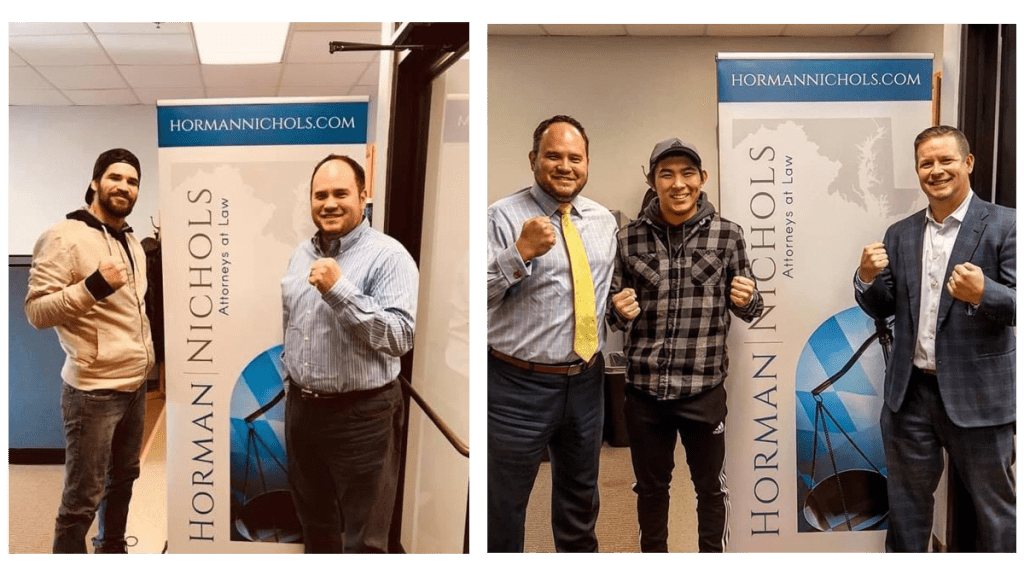
During my time at Clinch, I’ve gotten to know some of the guys who have gone pro in their MMA careers.  Horman Nichols has had the opportunity to sponsor Matt “Semi the Jedi” Semelsberger in one of his pro fights and we cheered him on during his first UFC victory.  

We’ve also had the privilege to sponsor Luke Staley in his amateur career and now again as he goes pro.  Matt and Luke personify hard work and determination, but are two of the nicest guys you’ll ever meet outside of the cage.  At Horman Nichols we love to support our local community.  Matt and Luke are great ambassadors of combat sports as well as Frederick and they’re going to do amazing things.  

Training at Clinch has been one of the best decisions I’ve made.  Professor Luke Rhinehart runs a great academy and the people I’ve met there are fantastic.  I’ve made some wonderful new friends and I’ve learned that sweating and bleeding on the mat together creates a bond unlike anything else I’ve experienced.  

4 Tips in a Personal Injury Case

Not everyone wants to hire an attorney for their personal injury case, and if you consult with an attorney, you should know you have the right to negotiate a settlement with the insurance company without an attorney and you have the right to file a lawsuit without an attorney.

Whether you choose to represent yourself in your negotiations with an insurance company, or you’ve retained an attorney, here are four things to keep in mind.


Horman Nichols – Legal Q&A Coming Soon

Ever had a legal question or scenario, but before you invested the time and expense of retaining a lawyer, you needed some direction to make sure it was worthwhile? We understand – email your question to us (anichols@hormannichols.com) and we will pick a handful of questions to respond to via video on our social media platforms.